
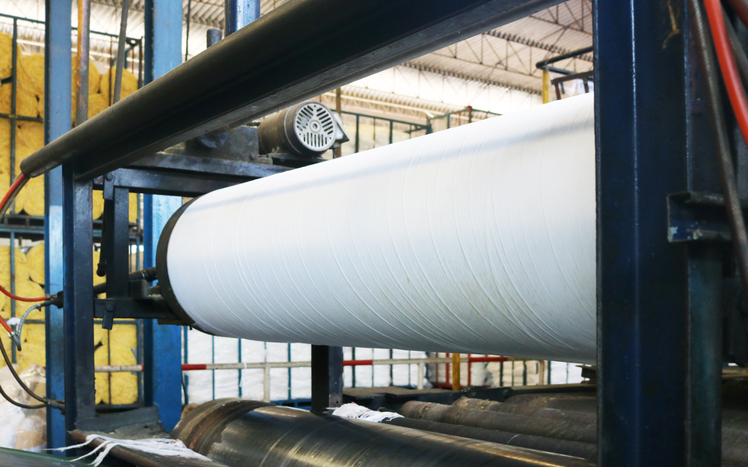
Why Surface Quality in Filament-Wound Composite Poles Starts at the Cure Stage
Composite utility poles are increasingly specified as an alternative to wood, steel, and concrete in applications where corrosion resistance, longevity, and weight matter. Filament winding is the dominant manufacturing process, well-suited for high-volume production and compatible with multiple thermoset resin systems. But the efficiency of filament winding can be undermined at a stage that’s easy to overlook: the oven cure.
Without the right overwrap applied before cure, a composite utility pole comes out of the oven with surface problems that cost time and money to fix. This is where heat shrink tape for composite utility poles becomes a process decision, not an afterthought.
Here, we’ll explore how Dunstone works with manufacturers to address this issue and help them create better quality components to bolster infrastructure projects nationwide.
What Happens Without an Overwrap Film
A manufacturer producing epoxy/glass composite utility poles via filament winding came to Dunstone with a persistent quality problem. They were curing large-diameter pole sections without any overwrap film before the oven cycle. The results were consistent and consistently problematic: rough surface finish, air voids, and part-to-part variation that made quality control difficult.
Two factors were at work. First, without a compressive film holding the outer surface, voids in the resin have no mechanism to be pressed out during cure. Second, because the poles are stationary during the cure cycle rather than rotating, resin migrates under gravity and pools on the bottom of the part. The result is an uneven surface that requires sanding, gel coating, or other secondary finishing before each composite utility pole can be delivered to customers.
For a product installed outdoors and left exposed to weather and debris over a service life measured in decades, surface finish carries real functional weight. Rough or inconsistent surfaces accumulate dirt and environmental buildup faster than smooth ones, compounding maintenance requirements over time.
How the 210S Tape Solved It
Dunstone recommended the 200 Series Hi-Shrink Tape — specifically the 210S variant at .002″ thick with 10% shrink — applied as a 2″ wide spiral wrap before the oven cure cycle.
The tape applies consistent compressive force as temperature rises, pressing the outer resin layer against the wound fiber structure throughout the cure. This eliminates surface voids and produces a uniform finish. Because the tape maintains compressive force even as the resin drops in viscosity, it also counteracts the resin pooling caused by the stationary cure orientation.
The outcome was a smooth surface finish achieved without sanding or gel coating the poles after cure. Secondary finishing steps were eliminated.
The Broader Process Consideration
Surface quality decisions made upstream in the process determine whether downstream finishing work is necessary at all. An overwrap film is a cure process tool, not a finishing tool. Selecting the right one and applying it correctly removes an entire category of post-cure labor.
The 200 Series handles a wide range of composite applications, including large-diameter tubular parts. For guidance on how tape thickness, shrink percentage, and wrapping technique interact with compressive force output, the Variables Affecting Compressive Force resource in our Engineer’s Corner is a useful reference.
Surface finish and void formation are not always the same problem. A related application involving composite utility pole production required a different solution: a manufacturer using a wet layup process was getting subsurface voids and dry spots caused by gaseous volatiles trapped under a standard non-perforated tape. The fix was perforated tape, specifically designed to allow volatiles to escape the matrix during cure. That application is covered in detail here.
For a broader context on filament winding in composite pole manufacturing, CompositesWorld’s coverage of filament-wound utility poles is worth reading.
Finding the Right Tape for Your Application
Composite utility pole manufacturing presents specific challenges around cure process design. The right tape selection depends on part diameter, resin system, cure temperature, and whether the part moves during cure. Dunstone’s engineering team has worked with composite manufacturers across a range of geometries and production environments.
To discuss your application or request a sample of Hi-Shrink Tape for testing, contact the experienced team at Dunstone.