
Why Composite Manufacturing Cost Reduction Efforts Miss the Consolidation Stage
Composite manufacturing cost reduction rarely begins as a cost reduction project. Engineers reach out because they have hit a throughput ceiling, porosity is turning up at inspection, or because a supplier’s lead times have stopped being reliable. Cost surfaces midway through the conversation, once it becomes clear the comparison being made is the wrong one.
The material applied to the outside of the part before cure is usually evaluated on price per roll. That number is easy to find and easy to compare across vendors. It also has very little to do with what the material costs to run.
The Cost That Never Reaches the Purchase Order
When a shop compares consolidation materials, the comparison is nearly always material cost per unit received. What it leaves out is how much labor and material each option requires to reach the same part or finished good they are producing.
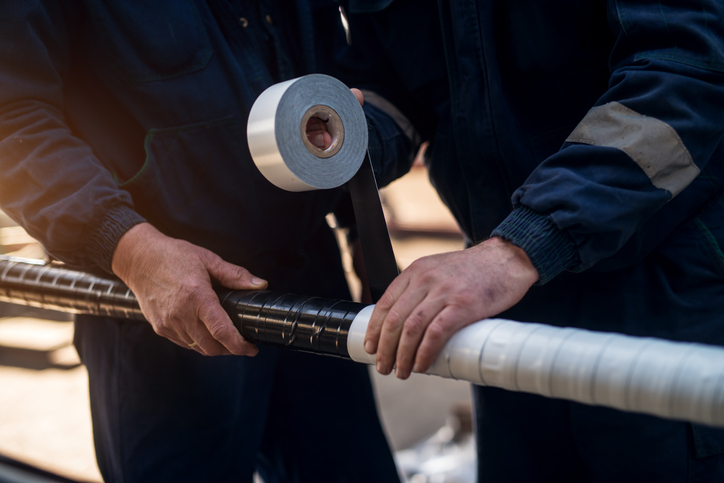
Consider a pattern we see often. A shop builds compaction a thousandth of an inch at a time, running 3/4″ to 3″ tape through five back-and-forth passes to accumulate roughly 50 layers. Material cost per roll is low. Wrapping time is not. Neither is removal time, which rarely gets counted at all.
Moving that part to a single layer of an engineered tape can produce comparable quality on the same cure cycle. Wrapping labor evaporates. Removal labor goes with it. The material line on the purchase order may go up, but the cost per part goes down.
The transition is not free. Wrapping tension and process parameters have to be dialed in, and early runs often show some adverse effects. Those typically resolve quickly with support from an applications engineer who can model the current process you are using and show you what tape would be best for your application.
Treating the Tape as an Engineering Variable
A 2025 cost study in the Journal of Manufacturing Processes modeled composite pressure vessel manufacturing across material, consumables, layup, curing, and labor. Of every variable examined, cure batching had the largest effect on vessel cost. The cure stage carries more economic weight than the engineering attention it usually receives.
Compaction Force Changes With Part Diameter
Compaction force is inversely related to part diameter. The same tape, applied the same way, delivers more force on a small tube than on a large one. A material that performs well at 2 inches can fall well short at 12. This relationship is documented and testable, and it sits alongside several other variables that determine compressive force on your part.
Force Has to Arrive During the Viscosity Window
Compaction force only does useful work while the resin can still flow. Peak force should be timed to the resin’s viscosity window, which most datasheets give you. Force arriving after gel is largely wasted, though usually harmless, since the tape has done its job by then. Most engineers we speak with have not looked at their resin’s viscosity profile. That reflects where consolidation sits on the priority list rather than any gap in capability.
One Number Will Mislead You
The most common modeling error is taking a single snapshot value, maximum or nominal shrink force, and plugging it into a formula. Force is a curve across the cure, not a number. Published curves also do not account for initial wrapping tension, which shifts the entire curve before heat is applied. Shrink percentage, thickness, diameter, and overlap all move together, and estimating any one of them in isolation shifts the whole model. That is a conversation worth having with Dunstone’s applications engineers before you commit to a material.
When the Cheap Material Costs More
Polypropylene (PP) base layers show how an economical material can behave expensively. Air escaping the laminate during cure needs a path out. PP can seal that path against the part surface, trapping volatiles and producing porosity in the finished laminate.
Two other limits matter. Deliverable force falls off as diameter increases, so PP performs better on small parts than large ones. And it loses mechanical integrity well below its melt point. Polypropylene melts near 160°C, but softening begins around 110°C, with continuous service limits between roughly 82 and 121°C by grade. A cure cycle that never approaches melting can still push the material past the point where it holds tension.
The Supply Case for Looking Now
Two things have shifted over the past year or two. Reshoring pressure and lead time problems have made incumbent supply less dependable, and some quality changes have arrived that do not show up on a datasheet.
Core material is the clearest example. Wrapping operations draw tension from the core, so a move from cardboard-style to plastic cores changes how the machine interacts with the roll. Spiked side plates built to seat into cardboard will not bite into hard plastic. Some shops work around this by melting seats into the plastic with a heated tool.
If supply has already put you in the position of evaluating alternates, that is the moment to evaluate the process alongside the material.
What a Change Actually Requires
Before recommending anything, we ask three questions. What are your current process parameters? Do you have a target compaction force? And what does a good part mean in your shop: visual inspection or a defined test method?
The second question is the revealing one. Most operations do not have a target compaction force, which means the current material was selected without one.
Plan on roughly three rounds of testing to dial a new material in. First-pass success is not something to count on. The shops that make the switch tend to be the ones under capacity pressure, where the throughput gain justifies the process work. Once one line proves out, adjacent programs follow quickly.
Start With What Your Tape Is Delivering
Composite manufacturing cost reduction usually shows up as a result of solving something else. Fix a throughput ceiling or a porosity problem at the consolidation stage, and the cost number tends to move on its own.
If you are wrapping today without a target compaction force, that is the place to start. Send us your part geometry, resin system, and current process parameters, and our engineers will model what your Hi-Shrink Tape is delivering across the full cure. Request a sample to test in your own production environment.